Fully AI-generated or AI-assisted content quickly became a tool for marketing teams looking to scale rapidly. The cornerstone of effective SEO over the last 15 years has been generating more news and blogs to help websites rank and build authority in search. Knowing that this principle still stands, the chase continues, and content creation leads efforts in organic digital marketing.
Fast forward to 2026, and the speed of content development has multiplied overnight, and marketing teams are pushing out blogs multiple times a week and increasing their website page count by hundreds each month. But is there a true gain?
SEO professionals take on AI performance
If you ask SEO professionals about the success of AI-generated content, over 72%1 of them say that it performs as well as or better than human-generated copy. Here is the truth: as an expert in SEO, you have to believe that the efforts you are making are incrementally improving your client’s presence. If you are able to push 3X the content you did in the past, you may see a combined improvement in traffic and visits for certain articles, which, when looked at from a collective standpoint, still shows an upward movement. And your effort to get there was a lot smaller. But from the big-picture perspective, is this sustainable, and at what point will the saturation be so massive that the needle will eventually stop moving?
The content is growing, and it is mostly thanks to AI
Ahrefs’ study of 900,000 newly detected pages in April 20252 found that 74.2% of those new pages contained AI-generated copy. Blog posts are the most common type of content created by AI. The AI detectors are good but not always 100% accurate, and as users of these tools, we can tell that occasionally even human content can be misclassified as AI. But Google still has a way to accurately rank new pages and posts created by people vs. LLMs.
AI models are getting better, and when comparing content from early 2025 to the deep research mode in 2026, the output results are significantly improving. But there is still one common thread that will continue to be the roadblock for any future content generation: none of the AI content is fundamentally new. It is ultimately regurgitated data from other sources without a thread of new thought or experience. When we stop “adding knowledge” to all the output, what value does it carry, and at what point will your efforts no longer yield any results?
Regardless of opinions, human content still leads
In early April 2026, Semrush3 performed an extensive study on keyword rankings and how pages performed when comparing AI-written and human-written content. The study took the following into consideration:
- 20,000 keywords were analyzed
- 42,000 blog posts were included in this study
As a result of the study, it became clear that human originality significantly outweighs content classified as AI-generated.
- Human-written content showed up in position #1 80% of the time, while purely AI content ranked in that spot only 9% of the time.
- This margin slightly narrows (70%-64% in positions 5-10), but it continues to prove that human knowledge and expertise are still being leveraged by search engines.
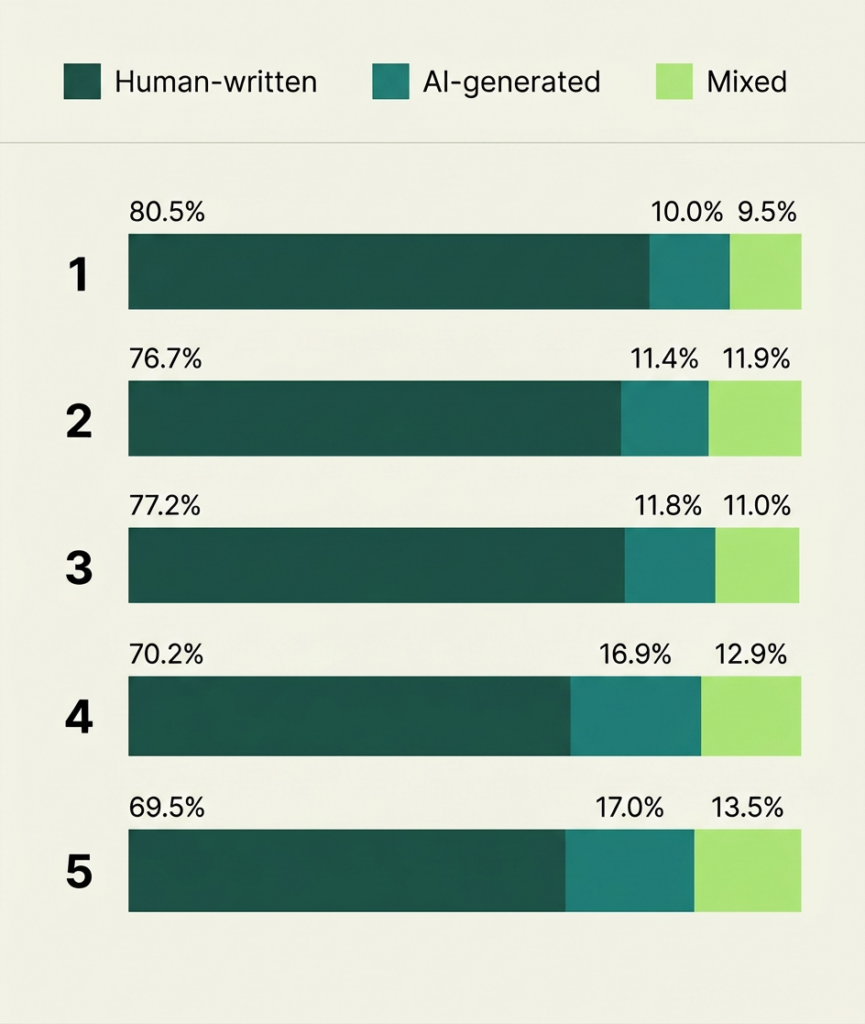
Source: Semrush
How does the future look?
Does this argument that human content outperforms AI even matter? We are looking at such a fast query drop in traditional search that by the time we finish 2026, we might be looking at only 50% or even fewer queries still being generated in the traditional Google setting. So, where should we shift our focus?
We can start by looking at how AI-generated content ranks in AI-based queries? The research is not as straightforward, and the results can vary when even the slightest adjustments happen in the prompt. Different results will display across various AI platforms, so bringing clean and reliable data is not really attainable at this time. And are we just building authority at that point, or still hoping for a click-through?
It’s an interesting time, and while many SEO experts tightly hold onto the belief of quantity over quality, they will eventually have to adjust to the new guidelines that LLMs will start to form.
Using purely common sense, if the data pool for AI models is saturated with the same content, only structured in various ways, where will the models turn to find more information? That’s where human-written expertise will continue to reign, and new research, data, originality, and forward-thinking will elevate a website’s authority and credibility. We believe this will eventually be rewarded with brand mentions where a click truly matters and turns into a conversion.
In summary, it’s still best to share research and opinions powered by a human perspective. There are no penalties; maybe there is no scale, but there is a clear value that machine learning cannot yet produce.
1,3 SemRush https://www.semrush.com/blog/does-ai-content-rank-in-search-data-study/
2 Ahrefs https://ahrefs.com/blog/what-percentage-of-new-content-is-ai-generated/